All Categories
Featured
Table of Contents
- – The Shift Toward Enormous Programmatic Scaling...
- – Building a Foundation with Structured Data
- – Managing Crawl Spending Plan for 1 Million Pages
- – Template Logic and Material Variation
- – The Function of User Intent in Large-Scale Co...
- – Future-Proofing Your Strategy for late 2026
- – The Balance In Between Automation and Human O...
- – Technical Hurdles and Solutions
- – Information Sourcing and Stability
- – Looking Ahead: The Development of Programmatic...
The Shift Toward Enormous Programmatic Scaling in 2026
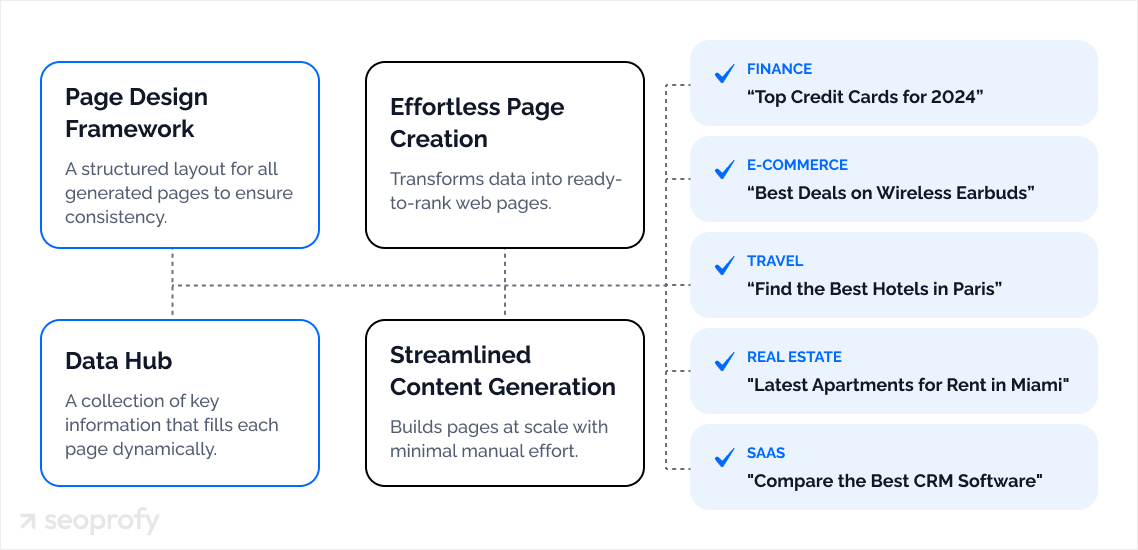
Growth in the search environment of 2026 depends upon how well a site manages volume without compromising specificity. Moving from a handful of pages to a directory site of one million requires a change in viewpoint. In the past, scaling content indicated working with more writers. Now, success originates from structured data and wise templating. A small collection of 100 pages serves as a testing room for reasoning that ultimately powers a huge existence throughout the web. The focus has moved far from simple keyword stuffing towards providing utility through specialized data sets that satisfy really specific user intents.
Online search engine in 2026 are much better at identifying thin material. They no longer index pages even if they exist. Each of those million pages need to prove it has a factor to be discovered. This means the underlying data need to be unique, verified, and formatted in such a way that offers immediate responses. When a website scales, the margin for mistake shrinks. A small bug in a design template that impacts 100 pages is a minor fix. That exact same bug on a million pages can result in a site-wide de-indexing. Dependability in data processing becomes the most crucial element in keeping exposure.
Building a Foundation with Structured Data
The journey to a million pages starts with a tidy database. Many failures in programmatic SEO take place because the source product is untidy or redundant. If the data used to generate Digital Asset Expansion is outdated, the resulting pages will bounce users back to the search results page. In 2026, search algorithms track "dwell time" and "interaction depth" more strictly than ever. A million pages of low-grade data are a liability, not a possession. Every row in a spreadsheet or every entry in a database must be treated as an individual piece of high-value information.
One way to guarantee quality is through information enrichment. This includes taking a fundamental data point and including layers of context. For example, a page should not just list a service. It must include local rates, accessibility, user-generated sentiment, and technical specifications. When business buy Rapid Digital Asset Expansion Systems, they are basically constructing a moat. It is simple for a competitor to scrape a public list, but it is much harder to replicate an exclusive data set that has actually been cleaned up and enriched gradually. This differentiation is what keeps a large-scale website relevant in 2026.
Managing Crawl Spending Plan for 1 Million Pages
Internal connecting is the map that search engine bots use to discover content. For a website with 100 pages, an easy menu suffices. For a site with a million pages, the architecture should be more sophisticated. In 2026, crawl spending plan is a limited resource that must be handled with precision. Flat website architectures are generally chosen, but they need a "center and spoke" model to make sure that no page is more than three or four clicks away from the homepage. Using automated internal linking makes sure that new pages get instant authority from established ones.
Pagination is often a trap for big websites. Rather of "Next" buttons, clever sites utilize categorical filtering and attribute-based navigation. This produces more entry points for online search engine and permits them to find deep pages through numerous courses. The need for Digital Asset Expansion across Verticals has actually led to brand-new methods of thinking of how bots traverse enormous directory sites. If a bot gets stuck in a loop of low-value filter pages, it may never ever reach the high-value content buried at the bottom of the stack.
Template Logic and Material Variation
Composing a design template for a million pages is an exercise in logic. It is not about writing one paragraph and swapping out a city name. In 2026, that technique is acknowledged as "spun" content and is strained. Modern design templates use conditional reasoning to alter entire areas of the page based upon the data readily available. If a particular data point is missing out on for a specific category, the template ought to avoid that area totally or draw in a different, appropriate block of text. This makes sure that every page feels hand-crafted even when it is generated by a script.
Variation surpasses just text. It includes the layout, the images, and the calls to action. A page for a technical audience ought to look and feel various than a page for a general consumer. By utilizing dynamic components, a single design template can adapt to hundreds of different situations. This level of elegance is what separates the leading 1% of programmatic websites from the rest. The goal is to make the user seem like the page was developed particularly for their search query, regardless of whether there are 999,999 other pages like it.
.jpg)
The Function of User Intent in Large-Scale Content
In 2026, online search engine are intent-focused. They attempt to understand why a user is searching, not simply what they are browsing for. When developing a million-page site, the information ought to be mapped to different stages of the funnel. Some pages will be purely informative, while others will be transactional. If the core database includes intent markers, the website can serve different variations of a template to match those needs. This prevents the "pogo-sticking" effect where users click a result and instantly leave since the content didn't match their expectations.
- Data Accuracy: Validating info against numerous sources to avoid misinformation.
- Page Speed: Ensuring that even with heavy information calls, the page loads in under 500 milliseconds.
- Mobile Optimization: Creating design templates that work throughout all screen sizes without losing information density.
- Semantic Importance: Using entities instead of just keywords to help online search engine understand context.
Future-Proofing Your Strategy for late 2026
The most significant hazard to a big programmatic site is an algorithm update that targets "unhelpful" material. To remain ahead, developers need to monitor the health of their pages constantly. This involves tracking which pages are being indexed, which are being overlooked, and which are really driving conversions. If an area of the website is underperforming, it might be time to rethink the information reasoning or the template design. Utilizing performance monitoring permits real-time changes before a little problem turns into a major traffic drop.
Another aspect of future-proofing is diversity. A website should not rely solely on one online search engine for all its traffic. In 2026, alternative search platforms and AI-driven answer engines are gaining market share. These platforms typically have different requirements for how they consume information. Offering clean APIs or structured feeds for data distribution can open up brand-new traffic channels that aren't reliant on conventional search outcomes. This multi-channel technique reduces the danger connected with handling a massive material footprint.

The Balance In Between Automation and Human Oversight
Even with a million pages, the human aspect can not be entirely gotten rid of. Human-in-the-loop (HITL) workflows are essential for preserving quality at scale. This may involve random sampling of produced pages for manual review or utilizing people to verify the "edge cases" in a dataset that the automation can't handle. If the reasoning for automated content produces an awkward or inaccurate sentence, a human editor must be able to flag it and update the design template logic for all comparable pages immediately.
This hybrid approach ensures that the site gain from the speed of automation while preserving the quality of manual curation. As we move through 2026, the websites that discover this balance are the ones that will dominate the search engine result. They supply the depth of a massive library with the accuracy of a shop publication. Scaling from 100 to 1 million pages is not just a technical accomplishment; it is an editorial one that needs a deep understanding of what users actually discover handy.
Technical Hurdles and Solutions
Handling the server load for a million pages requires a various stack than a standard blog. Fixed website generation (SSG) was popular for a long period of time, but for a million pages, the build times become difficult. In 2026, a lot of massive programmatic sites utilize incremental static regeneration (ISR) or advanced server-side making (SSR) with heavy caching layers. This permits the site to stay fast and fresh without requiring a 24-hour develop cycle whenever a single row in the database changes. Dependability in the infrastructure layer is simply as important as the material itself.
Database questions should also be enhanced. If a design template requires to pull information from 5 different tables to render a single page, which page gets an unexpected spike in traffic, the database could crash. Smart caching of data objects and using dispersed databases can mitigate these risks. When a site reaches the million-page mark, it stops being a simple website and begins becoming a complicated information application. The developers accountable for backend systems need to focus on uptime and question performance above all else.
Information Sourcing and Stability
Where does the information originate from? In 2026, there are more information suppliers than ever, but not all are developed equal. Some companies utilize public APIs, while others build their own spiders to collect details from the physical world. The most successful websites frequently combine these sources to develop something entirely new. If a page utilizes proprietary insights, it is a lot more likely to be ranked as "helpful" by online search engine. This is because it supplies details that can not be discovered anywhere else on the web.
- Primary Research study: Collecting data through studies or direct observation.
- Secondary Aggregation: Combining several public data sources into a merged view.
- User Contributions: Allowing users to add their own data points or corrections to existing pages.
- Algorithmic Inference: Using device finding out to forecast missing out on information points based upon existing patterns.
No matter the source, data integrity is paramount. A single inaccurate truth on a page can harm the reputation of the entire website. In 2026, "fact-checking" layers are typically developed directly into the programmatic pipeline. These layers compare the produced content versus known facts to make sure that the information output is accurate. Websites that stop working to do this threat being flagged as "AI-generated spam," which is a death sentence for any massive SEO job.
Looking Ahead: The Development of Programmatic SEO
As we look toward the end of 2026 and beyond, the meaning of a "page" is altering. We might see a shift from fixed URLs to vibrant reactions that are generated on the fly for particular users. Programmatic SEO will progress from building pages to constructing "information kernels" that can be served in lots of various formats. Whether it is a standard search engine result, a voice assistant answer, or a snippet in an AI chat, the underlying data strategy remains the same: supply the most precise, appropriate answer as effectively as possible.
The scale of one million pages is no longer a vanity metric. It is a reflection of the complexity of the modern world. Individuals have millions of various questions, and they anticipate particular, localized, and current responses for each of them. By mastering the art of scaling, organizations can satisfy this need and build a digital existence that is both huge and significant. The journey from 100 to 1 million pages is hard, however for those who prioritize information quality and technical quality, the benefits are substantial.

Table of Contents
- – The Shift Toward Enormous Programmatic Scaling...
- – Building a Foundation with Structured Data
- – Managing Crawl Spending Plan for 1 Million Pages
- – Template Logic and Material Variation
- – The Function of User Intent in Large-Scale Co...
- – Future-Proofing Your Strategy for late 2026
- – The Balance In Between Automation and Human O...
- – Technical Hurdles and Solutions
- – Information Sourcing and Stability
- – Looking Ahead: The Development of Programmatic...
Latest Posts
Bridging the Space In Between Quality and Automation
How Site & Page Builder Scale Material in 2026
How to Scale a Material Company in the AI Era
Latest Posts
Bridging the Space In Between Quality and Automation
How Site & Page Builder Scale Material in 2026
How to Scale a Material Company in the AI Era